Planning a motorhome trip in Germany and want to stay up to date with the latest regulations? You’re in the right place! Before hitting the road, discover everything you need to know about motorhome rules and regulations in Germany.
Driving and parking rules for motorhomes in Germany
Driving a motorhome in Germany
What driving license do you need?
If you plan to drive a motorhome weighing 3.5 tonnes or less, a Category B driving license is sufficient in Germany. However, if your vehicle exceeds this weight, you will need a Category C1 or C license.
Even though no special license is required, driving a motorhome does require some adaptation. Here’s a tip: before setting off, always keep your vehicle’s dimensions in mind (height, width, length). Also pay close attention to blind spots and turning radius.
- Stay alert: many roads, bridges, and parking areas may have height restrictions. If you come across a location listed on CaraMaps with a height barrier, consider leaving a comment to inform other travelers.
Is there a specific Highway Code for motorhomes?
In Germany, the StVO (Straßenverkehrsordnung) applies equally to cars and motorhomes. However, vehicles over 3.5 tonnes must comply with different speed limits.
| Less than 3.5 tonnes | Over 3.5 tonnes | |
| Urban areas | 50 km/h | 50 km/h |
| Rural roads | 100 km/h (80 km/h with trailer) | 80 km/h (60 km/h with trailer) |
| Motorways (Autobahn) | No general speed limit* (recommended 130 km/h) | 100 km/h (80 km/h with trailer) |
Always respect local regulations, as some municipalities may impose restrictions based on vehicle size. Driving slower (“slow travel”) is often safer and more enjoyable.
What tolls do you need to pay when traveling by motorhome in Germany?
For several years now, the question of tolls has often come up among travelers planning to cross Germany by motorhome. Unlike many other European countries, the German motorway network is free for motorhomes.
- Germany does operate a heavy goods vehicle toll system (LKW-Maut). Initially introduced for vehicles over 7.5 tonnes, it was extended at the end of 2023 to vehicles over 3.5 tonnes. However, this system only applies to vehicles used for the commercial transport of goods.
- As a result, motorhomes—even those over 3.5 tonnes—are not subject to this toll, as long as they are used for private purposes. You can therefore drive freely on German motorways without paying any fees.
There are, however, a few exceptions to this rule. These concern the Warnow Tunnel and the Herren Tunnel, where a toll must be paid depending on your vehicle’s category and number of axles.
- For the Warnow Tunnel, expect to pay around €4 if your motorhome is taller than 2.05 meters, and up to €9 if it is 2.60 meters or higher (off-season rates). For the Herren Tunnel, the toll is approximately €3.50 to €4.00 for a standard two-axle vehicle, with a height of about 1.30 meters above the front axle.
In summary, traveling by motorhome in Germany offers a major advantage: most of the road network is toll-free, with only a few rare exceptions.
Motorhome parking in Germany
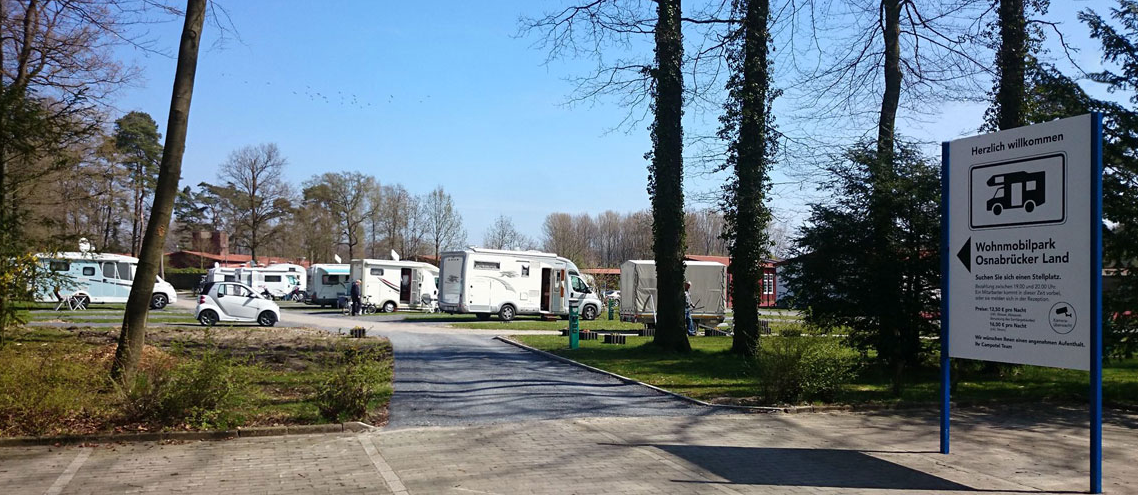
When it comes to parking, motorhome drivers must follow the German Highway Code (StVO), just like car drivers. Most motorhomes, campervans, and converted vans are allowed to park in public spaces, along roadsides, or in parking areas. However, some restrictions apply, particularly for vehicles over 3.5 tonnes.
Important: camping ≠ parking
- It is often forbidden to “camp” outside designated areas.
- In standard parking areas, make sure you:
- Do not set up awnings, tables, or outdoor furniture.
- Keep your leveling blocks discreet and not visible from outside.
General rules to keep in mind
- Parking is prohibited in narrow streets. There must be enough space to allow other vehicles to pass (approximately 3 meters minimum).
- There is no general time limit for parking your motorhome, as long as there is no specific signage (parking meter, time restriction, etc.). However, if your vehicle exceeds 7.5 tonnes, you are not allowed to park in residential areas between 10 PM and 6 AM, or on Sundays and public holidays.
- Be aware: long-term parking on public roads (several consecutive days) may be considered abusive or treated as an “abandoned vehicle”, and may therefore be prohibited depending on local regulations.
- If your motorhome has seasonal license plates, you are not allowed to park it in public spaces outside the authorized period indicated on the plate.
- Your motorhome must remain within the marked parking lines.
- Vehicles over 2.8 tonnes are not allowed to park on sidewalks. More generally, sidewalk parking is prohibited unless explicitly authorized by signage.
- You may park your motorhome on private property, provided you have the owner’s permission.
- Have you heard about CaraMaps Hosts? A CaraMaps Host is a private individual who offers a space and services to traveling motorhome users. Becoming a host is a great opportunity to make use of available space while earning additional income. For more information, check out our FAQ!
Wild camping in Germany with a motorhome
There is no single national regulation specifically governing overnight stays in motorhomes in Germany. The rules are based both on the German Highway Code (StVO) and on local regulations, which may vary depending on the region.
In principle, wild camping is prohibited. However, there is a degree of tolerance for drivers who need to stop and rest in order to “restore their fitness to drive”. This means that you are allowed to park temporarily, for example in a parking area or designated spot, to spend one night before continuing your journey.
- Important: behavior that resembles “camping” is not allowed during this stop. You should avoid setting up awnings, outdoor furniture, or equipment. This rest period is intended to be short and discreet, typically limited to one night.
- If you choose to camp without authorization, you risk fines ranging from €10 to €500, and up to several thousand euros in protected areas.
Driving on forest roads is prohibited without authorization. These restrictions are usually clearly indicated by road signs. Parking and/or camping in nature parks or biosphere reserves is also strictly forbidden.
- If you want to camp in a safe and legal way, it is recommended to use official campsites or service areas, which you can easily find on our map.
It’s also important to note that wild camping tolerance can vary by region. For example, Bavaria is known to be particularly strict, especially due to its many protected natural areas.
👉 Always make sure to check local regulations in advance, depending on the regions you plan to visit.
Want to learn more about this topic? Check out our blog article: “The best places for wild camping in Germany” 🚐
Recent changes in motorhome regulations in Germany
Environmental restrictions
Since 2008, Germany has introduced numerous environmental zones (Umweltzonen) to reduce air pollution, particularly in large cities. Today, there are several dozen zones (around 50 depending on sources), with some having been removed over time while others remain active.
To drive within one of these environmental zones, your vehicle must display an emissions sticker (Umweltplakette) on the windshield. This requirement also applies to foreign-registered vehicles.
To find the official map of environmental zones and more information, you can visit the relevant website.
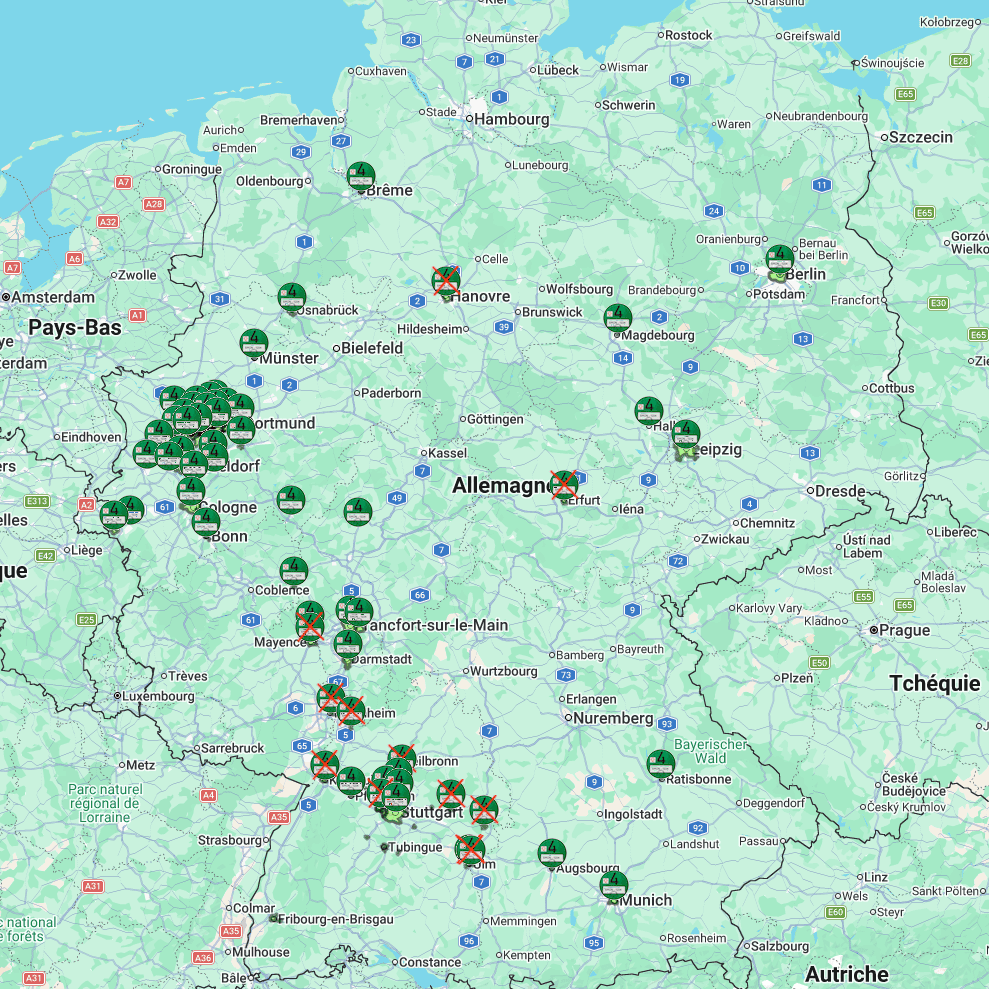
There are four categories of polluting vehicles (with a specific additional category for electric vehicles). We recommend checking the official website to obtain the correct sticker for your vehicle.
- Today, in most environmental zones, only the green sticker is accepted. Older or more polluting vehicles are therefore not allowed to enter these areas.
- Driving without a valid sticker in an environmental zone can result in a fine of approximately €100, including for foreign travelers.

Gas system inspection
Since 2023, the gas system inspection (G607) has once again become mandatory for motorhomes in Germany. This inspection is used to check the entire gas installation of the vehicle, including gas bottles, regulators, hoses, and appliances.
- This inspection must be carried out every two years by a certified technician or authorized organization.
- In some cases, it can now be linked to the technical inspection (HU), but it remains a separate legal requirement.
In the event of a fault or if the inspection is missing or no longer valid, the vehicle may fail the technical inspection and lose its roadworthiness approval.
Increase in fines for motorhomes
Since 2021, Germany has tightened its legislation on speeding offences. As a result, fines for both cars and motorhomes have increased significantly.
For example, for speeding up to 10 km/h over the limit in urban areas, fines are currently around:
- €30 for vehicles under 3.5 tonnes
- €40 for vehicles over 3.5 tonnes
Essential equipment for motorhomes in Germany
Before driving in Germany, make sure your motorhome is properly equipped. You must have on board a reflective safety vest, a warning triangle, and a compliant first aid kit. In the event of a roadside check, their absence may result in a fine.
Regarding tires, Germany applies a so-called “situational requirement”: winter tires are mandatory whenever weather conditions require them (snow, ice, slippery roads). They must be marked M+S, or ideally 3PMSF (snowflake symbol). In case of non-compliance, you risk a fine of approximately €60 to €120, and your liability may be engaged in the event of an accident. In practice, they are recommended from October to Easter.
For greater safety, it is also advisable to bring some additional equipment such as a fire extinguisher, a flashlight, jump cables, or even snow chains, especially in mountainous areas. 🚐
Planning a road trip in Germany? Discover our bonus itinerary for a Germany travel experience here!

In addition to this great itinerary in Germany, discover other routes in the country shared by the community, such as “From South to North Germany”, “A Journey Through the Land of 1,000 Lakes: Mecklenburg”, and many more!
Did you enjoy your road trip experience with CaraMaps and the advice from the community? Share your best stories or photos from your trip on the places you visited and more thanks to the 100% collaborative CaraMaps app 😊
Also follow us on our Instagram page @caramaps, where you’ll discover incredible spots. You can also find us on Facebook, where you’ll see new locations, new itineraries, and the latest news from the motorhome world every day!