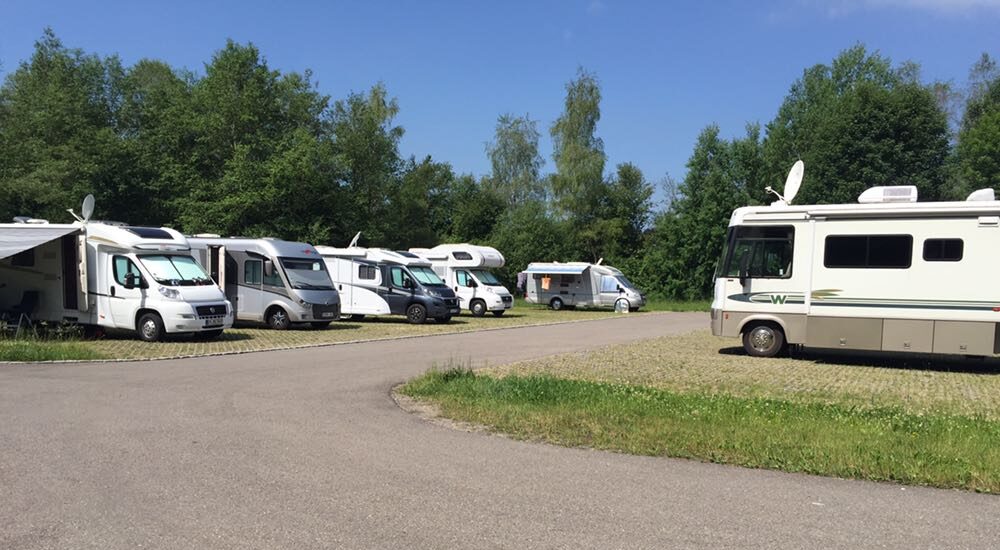

Greece is a highly popular destination for motorhome travellers, offering varied and breathtaking landscapes. However, it is essential to understand the current regulations in order to avoid unpleasant surprises. In this article, discover everything you need to know about motorhome regulations in Greece!
What documents do you need to travel to Greece in a motorhome?
Before travelling to Greece in a motorhome, it is essential to carry the following documents with you:
- Valid ID card or passport: A valid identity document is required to enter Greece.
- Driving licence: A standard category B driving licence is sufficient to drive a motorhome weighing 3.5 tonnes or less. For vehicles over 3.5 tonnes, a C1 or C licence is mandatory.
- Vehicle registration document: Essential document to prove the registration and technical characteristics of the vehicle (in particular the Gross Vehicle Weight Rating – GVWR).
- Vehicle insurance: The registration plate serves as proof of insurance in Greece, but you should still carry your insurance certificate or the “insurance memo” provided by your insurer (in case of a police check or accident).
- European Health Insurance Card (EHIC): Recommended in order to receive healthcare coverage if needed.
- European accident statement: Useful in the event of an accident to simplify insurance procedures.
Motorhome driving rules in Greece
Local driving rules
Before hitting the road in a motorhome in Greece, it is important to follow the local driving regulations:
- Driving on the right-hand side: As in most European countries, vehicles drive on the right.
- Right of way: In roundabouts, unlike in France, priority is often given to vehicles entering the roundabout, although this is not always the case. It may depend on road signs, so stay alert!
- Maximum blood alcohol level: 0.5 g/l of blood (0.2 g/l for drivers with less than two years of driving experience).
Speed limits in Greece
Speed limits are similar to those in other European countries and vary depending on the vehicle weight:
- 50 km/h in urban areas
- Outside urban areas:
- 90 km/h for vehicles under 3.5 tonnes.
- 80 km/h for vehicles over 3.5 tonnes.
- Expressways:
- 110 km/h for vehicles under 3.5 tonnes.
- 80 to 85 km/h for vehicles over 3.5 tonnes.
- Motorways:
- Up to 130 km/h for vehicles under 3.5 tonnes (depending on the road section).
- Around 100 km/h for vehicles over 3.5 tonnes.
Always pay attention to local road signs, as some roads may have specific restrictions, especially in mountainous or tourist areas.
Specific local conditions in Greece: driving tips
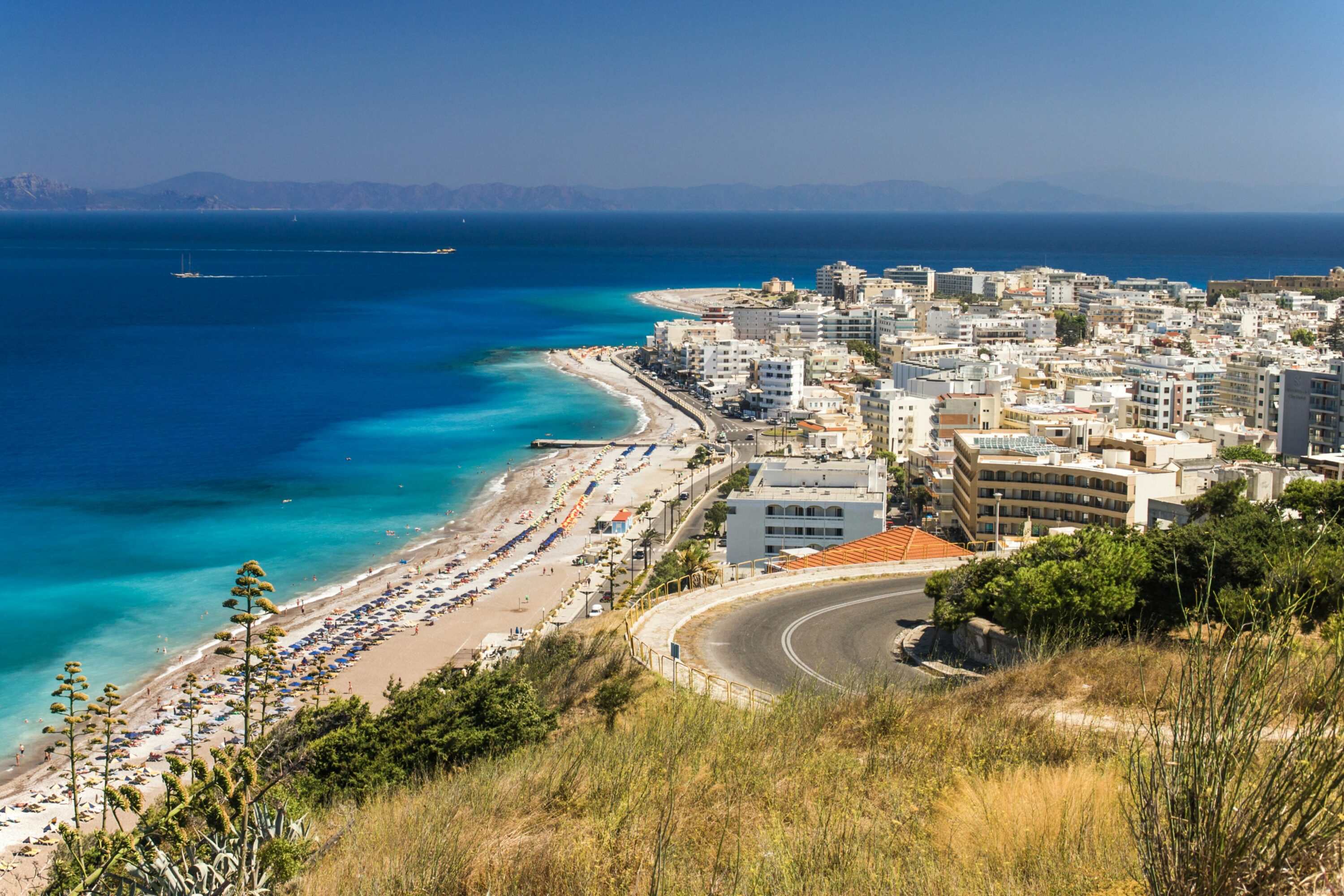
First of all, roads can be narrow and winding, especially in mountainous regions, villages, or on the islands. It is therefore recommended to stay cautious, particularly when driving a large vehicle, and to anticipate difficult crossings.
Local driving habits can also be surprising: frequent overtaking, right-of-way rules not always respected… Adopt a careful and defensive driving style for greater safety.
During summer, high temperatures can quickly put your vehicle under strain. Make sure to regularly check:
- The coolant level.
- Tyre pressure.
- The proper functioning of the air conditioning system.
It is also recommended to avoid driving during the hottest hours of the day.
Finally, in certain regions, especially on islands or in remote areas, petrol stations and water supply points may be harder to find. Plan your fuel and water refills in advance to avoid unpleasant surprises.
Essential equipment for travelling in a motorhome in Greece
Before setting off in Greece, it is important to make sure that your motorhome is properly equipped. Some items are mandatory and may be checked by the authorities.
You must carry a warning triangle, a first aid kit, and a fire extinguisher on board, the latter being particularly important due to the risk of wildfires, especially during summer. A high-visibility safety vest is not always mandatory, but it is strongly recommended for your safety.
👉 In the event of a roadside inspection, the absence of this equipment may result in a fine.
For additional safety and comfort, it is also recommended to bring useful equipment such as a flashlight, jumper cables, and extra water supplies, particularly when travelling in isolated areas where infrastructure may be limited.
Toll fees in Greece
In Greece, toll fees vary depending on the vehicle category, which is often determined by the vehicle’s height. Motorhomes are generally classified as Category 2 vehicles, with higher toll rates than standard cars.
On some roads, cameras automatically detect the vehicle height: if the motorhome exceeds a certain size, it may be reclassified into a higher category. Payment can usually be made by cash, bank card, or electronic toll systems. It is possible to avoid these costs by taking secondary roads, although these are sometimes less well maintained.
For more information about toll prices, you can consult this website.
Exploring the Greek islands by motorhome
If you want to explore the Greek islands by motorhome, you will need to take a ferry. Here is what you should know.
- Advance booking recommended: During high season, spaces for motorhomes on ferries are limited. It is advisable to book in advance.
- Variable pricing: The cost depends on the length of the motorhome and the destination. Expect to pay between €50 and €150 per crossing, depending on the island.
- Some ferry companies offer “camping on board” options, allowing travellers to sleep inside their vehicle during the crossing (for example on ferries to Crete).
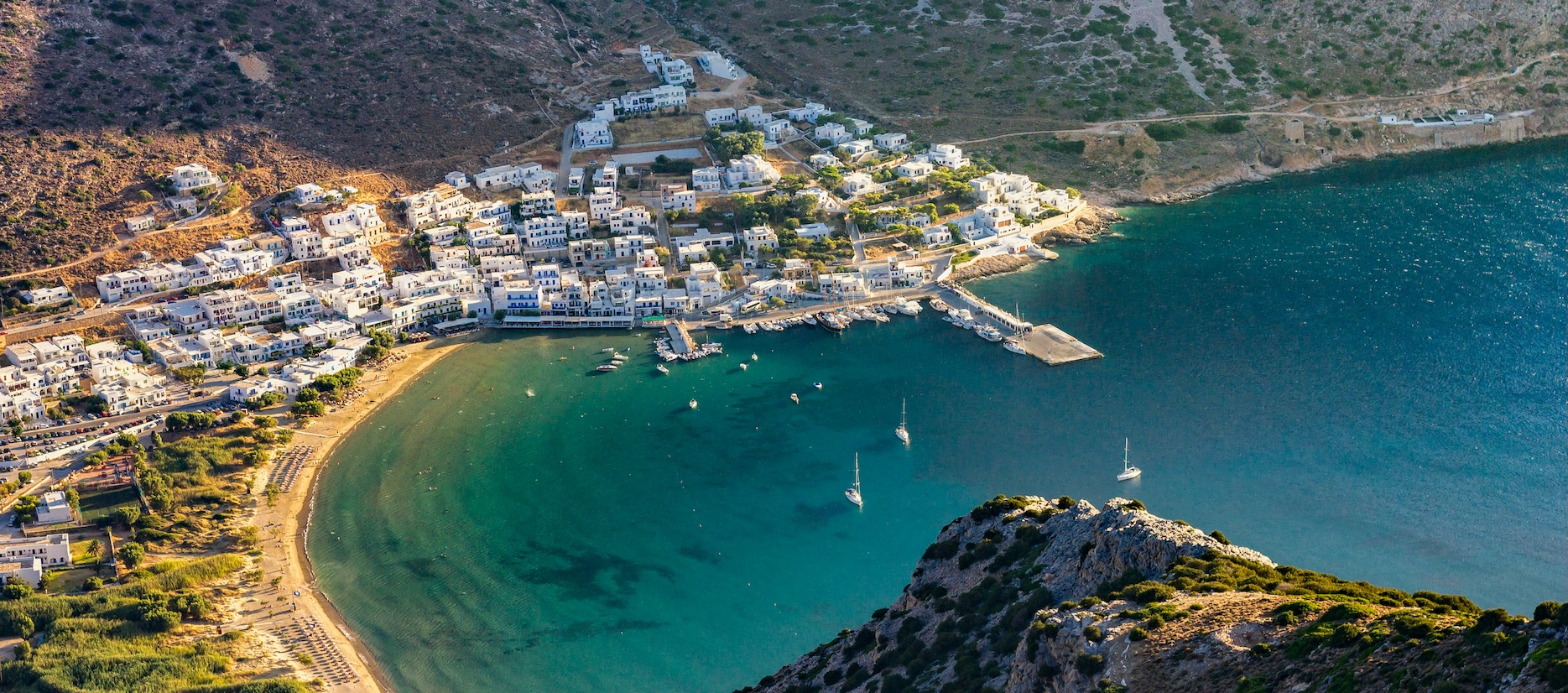
Be aware that some islands are stricter than mainland Greece regarding wild camping, especially Santorini and Mykonos.
Motorhome parking rules in Greece
Wild camping in Greece: what does the law say?
Wild camping is strictly prohibited in Greece. This ban applies both to setting up equipment (tent, awning, outdoor furniture) and to spending the night outside authorised areas, even without visible installations.
- Warning: camping ≠ parking
- This means that even spending a single night outside authorised areas may be considered an offence.
- In parking areas, it is therefore essential to remain very discreet: do not put out an awning, table, or outdoor furniture, and avoid any visible installations.
- In some cases, simply sleeping inside your vehicle may be considered camping, especially in tourist or protected areas.
Local authorities carry out regular inspections, particularly in tourist areas. In the event of an offence, you may face substantial fines, generally ranging from €300 to €3,000. In some cases, a fine may be applied per person, and the vehicle may even be immobilised.c
Here are some examples of places where the regulations are particularly strict:
- Delphi region: complete prohibition in order to protect the UNESCO-listed archaeological site.
- Cyclades islands (Santorini, Mykonos, Paros, etc.): frequent inspections and strict bans to limit tourist impact.
- Mount Olympus National Park: protected natural area where all forms of wild camping are prohibited.
- Protected beaches, such as those in Zakynthos (Navagio Beach): stricter regulations to preserve wildlife, particularly loggerhead sea turtles.
- Certain areas of the Peloponnese: local restrictions aimed at protecting natural landscapes.
To avoid any issues, it is strongly recommended to use official campsites or authorised parking areas. This guarantees parking that complies with local laws while limiting environmental impact.
Where can you legally park your motorhome in Greece?
Campsites in Greece
Greece has a well-developed network of campsites, particularly along the coastlines and on the islands. Prices generally range from €15 to €40 per night, depending on the season and the facilities offered.
Many campsites provide simple overnight packages for motorhomes, including access to sanitary facilities and waste disposal stations. Some also offer off-season discounts and reduced rates for longer stays.
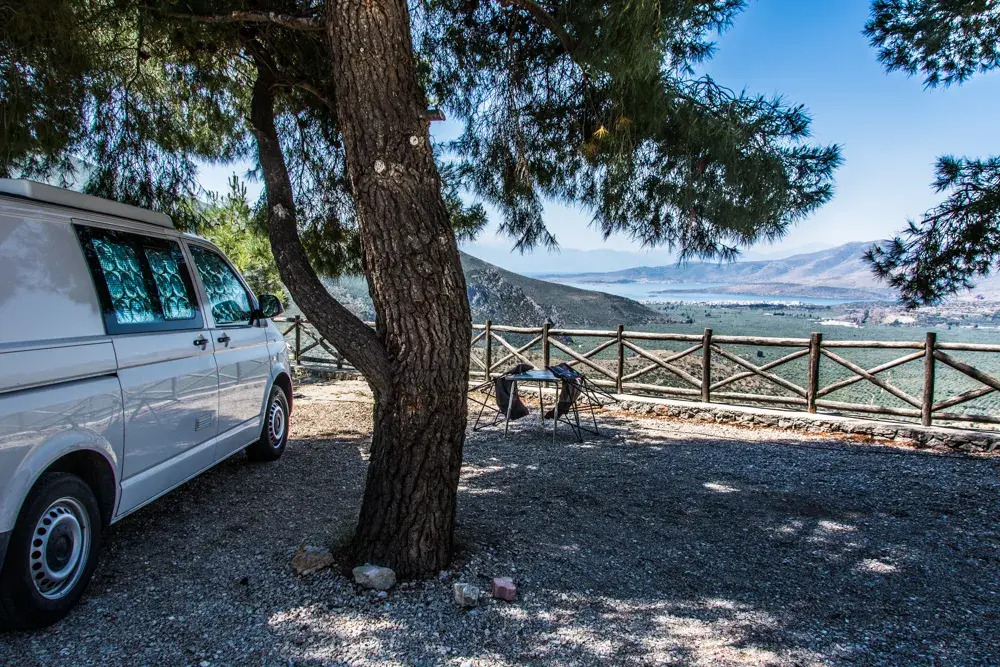
Motorhome service areas
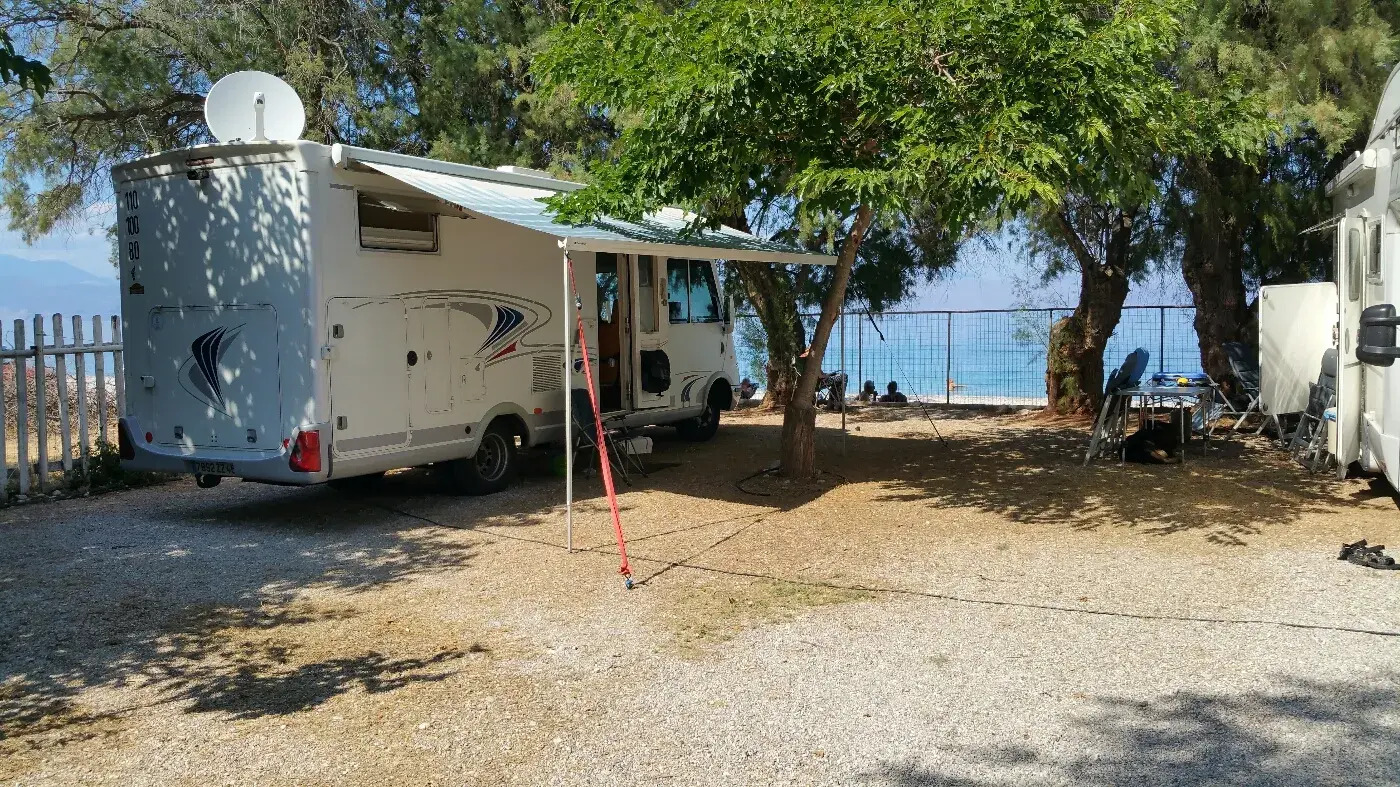
Unlike some other European countries, Greece still does not have a structured nationwide network of motorhome service areas. However, some petrol stations allow travellers to refill water tanks and empty waste tanks (sometimes for a small fee). Certain campsites also allow access to their waste disposal facilities without requiring an overnight stay.
On the CaraMaps motorhome app, you can access many official parking areas and campsites. Here are a few suggestions for your motorhome trip in Greece:
👉 Ready for a motorhome road trip in Greece? Download CaraMaps now and start planning your journey!
Feel free to read our other guides for travelling around Europe by motorhome, such as “Motorhome rules in Italy 🇮🇹”, “Motorhome rules in Spain 🇪🇸”, and many more!
And don’t forget… CaraMaps is the essential app for motorhome and van travellers, with more than 100,000 locations listed across Europe!